Showing posts with label Historical. Show all posts

The Disappeared by Gloria Whelan

| | 3 comments »
The Disappeared by Gloria Whelan http://www.avdistrict.org/library/y0808.jpg

As I may have mentioned before, my undergrad degree is in Hispanic Studies.*  One of my first upper-level Spanish classes  was Cultures of Dictatorship,  where we studied the totalitarian regimes in Argentina (1976-1986) and Chile (1973-1990), and the cultural production (film, novels, poetry, etc) that came out of both countries during this time.   It was a difficult but interesting class, and I finished the semester even more interested in this period of history -- which is why I was excited to hear about The Disappeared

But first, a brief history lesson (I'm assuming here that your high school history classes, like mine, probably never got past the Second World War):

You've seen Evita, right?  Well, after Eva Peron died in 1952, her husband, Juan Peron stayed in power in Argentina for a few more years -- then there was a coup, the military took control of the government, Peron was exiled, and he remarried while in exile.  He came back into power in 1973, then promptly died, leaving Isabel, his wife/vice president, in charge.  In 1976, there was another coup, and another military junta took control of the government. 

And thus began the Guerra sucia (Dirty War), in which the government, scared of another uprising, began systematically kidnapping any citizens expected of being subversivos or revolutionaries.  Those kidnapped were taken to secret prisons, tortured, and sometimes killed.  The government refused to give their families any information on their whereabouts, and thus, they came to be known as los desaparecidos or The Disappeared. 

This horrible period in history is the backdrop for Gloria Whelan's The Disappeared.  The novel alternates between two narrators, brother and sister, Eduardo and Sylvia.   A university student, Eduardo begins participating in protests, and is arrested for his activities.  Sylvia, his younger sister, meets a boy whose father is a high-ranking general, and she decides to seduce him in hopes that he might be able to free her brother. 

Whelan's writing is lyrical and poetic, and the novel moves along quickly, but for some reason I never really felt involved in the story.  I felt as if I was watching the story play out on the screen, rather than experiencing it.   I don't think this is the fault of the author, however.  I simply had expectations for the novel that it couldn't match.   I wanted more insight, more of a personal look into a period of history that I'm already pretty familiar with on academic terms -- I wanted to be able to connect with the characters so that I vicariously experience life during the dictatorship -- and The Disappeared did not fulfill those expectations.

However, I would still recommend the novel for teens -- this period of history will most likely be completely unknown to them, and this novel is a good introduction for those who are completely unfamiliar with it.   It is important, I think, that teens realize that that such horrors have happened in the recent past -- and that our government was at least an implicit supporter of these military regimes.**


More information on the Dirty War and los desaparecidos:
http://en.wikipedia.org/wiki/Dirty_war
http://www.yendor.com/vanished/

These two films are also very interesting:
La Historial Oficial (The Official Story)
Missing


*essentially -- cultural studies... in Spanish

**Don't even get me started on Kissinger

Newes from the Dead by Mary Hooper

| | 0 comments »
Newes from the Dead by Mary Hooper http://hbpub.vo.llnwd.net/o16/jackets/carousel_jpg/9781596433557.jpg

I don't know if its the cooler weather, the start of school, or the fact that I bought a memory-foam mattress pad that makes my bed unbelievably comfortable...  But whatever the reason, I think my reading slump might finally be over.   I picked up Newes from the Dead  a couple nights ago (like Suite Scarlett it had been sitting in my library basket for way too long), and finished it in one night.

The premise of the novel would be unbelievable -- if you didn't know that it was based on a true story.  Anne Green has been hanged in punishment for an unnamed crime (which is explained later).  She has been declared dead, and her body is being prepared for a dissection.  Robert, a young medical student, is anticipating his first dissection, when he sees her twitch...

Anne is still alive.

Told in alternating chapters, from the perspectives of Anne (as she regains consciousness) and Robert, the novel completely captured my attention.  The voices of both narrators were easily distinguishable, and the story moves at a quick pace (partly because the reader just has to keep turning the pages!)

I would definitely recommend Newes from the Dead to fans of historical fiction -- but I think the appeal of this novel may be broader than that, and could be a good pick for students who normally prefer thrillers (but have to read historical fiction for a book report!)

Readers might also enjoy:

Witch Child by Celia Rees
At the Sign of the Star and A True and Faithful Narrative by Katherine Sturtevant
The Minister's Daughter by Julie Hearn

Other Reviews:
Kids LitInteractiveReader's interview with the authorSarah MillerInteractiveReaderThe Reading ZoneBook Obsession 

Round Up #1 -- Why I really, really, really want to go to Australia!

| | 2 comments »
Must. Go. To. Australia.


Now, I know this is a huge generalization, but the more Australian YA fiction I read, the more I'm convinced that this is the future of the "genre". I still have yet to find an Australian author that I don't absolutely fall in love with upon reading their books. And I've read a few of them in recent months (yes, my blog post back log goes back to January)...


And first, about these round-up posts, I realized that many of my readers were coming from google searches for specific titles, so I wanted them to leave my site with a few ideas for other titles they might like, and of course, all of the recommendations are novels that I have read.


48 Shades of Brown by Nick Earls


While his parents are living in Switzerland, Dan moves in with his mother's much younger sister, and spends his senior year of high school battling calculus and falling for his aunt's other roommate.


After Summer by Nick Earls

After graduating from high school, Alex spends the summer at the shore waiting for his college-entrance results and meets a beautiful girl on the beach.


Other blog reviews (of both of these titles):

Chasing Ray


Readers might also enjoy:

Looking for Alaska, It's Kind of a Funny Story


Secret Scribbled Notebooks by Joanne Horniman


In three journals, Kate describes her daily life, the birth of her niece, the books that she reads, and her first experiences of love,


Other blog reviews:

Bookshelves of doom, Writings of the Loud Librarian, I'll eat my words medium rare, thank you,


Readers might also enjoy:

Anne of Green Gables -- something about Kate's dreamy ramblings reminded me so much of Anne

This is All: The Pillow Book of Cornelia Kenn -- journals, teenage girls... but a bit, um, bigger?


The Wolf by Steven Herrick


In this novel of poems, Jack and Lucy go out into the woods in search of a legendary wolf, where an accident causes them to learn about themselves, and each other. (apparently, they don't have wolves in Australia?)


Other blog reviews

The Small Picture (this reviewer also links to an interview with the author)

The Lick and Sniff Reviews


Readers who enjoy novels in poem form may also enjoy Sold, The Braid, and A Bad Boy Can be Good for Girl

Also, something about the woods and the friendship between Jack and Lucy really reminded me of Ronia: the Robbers Daughter .


One Whole and Perfect Day by Judith Clarke


In one of this year's Printz honorees, Lily hopes that her entire family will be able to get along and share one "whole and perfect day" despite all their differences; through a series of coincidences, this day is more than anyone could have imagined.


Other blog reviews:

Liv's Book Reviews, In the Pages, The Goddess of YA Literature


Readers might also enjoy:

Looking for Alibrandi and Saving Francesca by Melina Marchetta (and her new book is finally coming out here in August!)

Feeling Sorry for Celia and The Year of Secret Assignments by Jaclyn Moriarty


Spell Book of Listen Taylor by Jaclyn Moriarty


A story of family secrets, espionage, and magic, The Spell Book of Listen Taylor is completely unique. I do agree with many of the other bloggers that this title might be better suited to adults, not because it is inappropriate for teens, but because the main characters are closer to middle-age.


Other reviews:

Bookshelves of Doom, Roger Sutton's review from the NY Times, Interactivereader


Readers might also enjoy:

This book is so original that I have absolutely no idea... feel free to leave suggestions in the comments!


The Red Shoe by Ursula Dubosarsky


The story of three sisters growing up in Australia in the period immediately following WWII, a time when the fear of communism was rampant, and a polio outbreak was sweeping the country.


Other reviews:

Lowly's Book Reviews


Readers might also enjoy:

The Loud Silence of Francine Green (same time period, but here in the US)


Notes from the Teenage Underground by Simmone Howell (ummm... I think I read this one last summer, but somehow I never blogged about it)


Gem, a film buff, plans to spend the summer after her final year of high school making a film with her two best friends.


Other blog reviews:

Pages Et Cetera, Chasing Ray


Readers might also enjoy:

novels by Melina Marchetta and Nick Earls (see links above).

Julie, An American Girl by Megan McDonald

| | 2 comments »
Julie, an American Girl by Megan McDonald
I remember getting my very first American Girl catalog in the mail*. I was about four years old, and I spent hours pouring over the pictures of the dolls and their outfits and accessories. Of course, back then, there were only three dolls, and three books about each of them. (Personally, Molly was my favorite, because of the braids -- and I got her for Christmas when I was five). A few years later, when American Girl released the Felicity series, I was lucky enough to attend Felicity's Elegant Tea-Party in Colonial Williamsburg. So, of course, I was excited to hear about Julie, the newest American girl, whose novels are set in the 1970s.
As the first novel begins, Julie, a 9 year-old living in San Francisco, is packing up to move out of her old house. Her parents are getting divorced, and she and her older sister are moving into a small apartment with their mother. For Julie, this means leaving her best friend (Ivy), and starting 4th grade at a new school. However, when she starts school and tries to join the basketball team, she finds out that girls are not allowed. In typical American Girl fashion, she starts a petition to fight for her spot on the team.
Like all American girl novels, these titled are peppered with cultural and historical references, (In one book, Julie asks her mom what Watergate is). To me, some of these references seemed a little bit forced, but this may be more because I'm reading them as an adult than from any flaw in the writing.
I also have a few quibbles with the historical accuracy. For example, Julie decorates her locker at school, and while I'm sure there were lockers in the 1970s, I'm not sure that they had them in elementary schools (none of the elementary schools here in Virginia Beach have them today, and I noticed that in The Wednesday Wars, the junior high still had cloakrooms and cubbies instead). Any librarian types want to verify this for me?
Regardless, tween girls will enjoy this glimpse into the era in which their parents were growing up.

To find any of the titles in a library near you, see below:

Meet Julie: an American girl

Julie tells her story

Happy New Year, Julie

Julie and the Eagles

Julie's Journey

Changes for Julie

(And, there's even a DS game!)

A few other random links --

A search of the blogosphere revealed this adorable blog about American Girl dolls and books written by two ten-year-olds (which makes me a bit sad that blogs didn't exist when I was 10)

Also, weirdly, when I looked at the Wikipedia page for American Girl, I found some possible errors, such as "The stories were originally written by author Daniel Steele"

*This may, in fact, have been the very first American Girl catalog ever.

The Wednesday Wars by Gary Schmidt

| | 1 comments

The Wednesday Wars by Gary Schmidt

"The quality of mercy doesn't drop much from Gym teachers" (58)

Seventh grader Holling Hoodhood has it rough. While everyone else in his class is attending either Chinese School or Hebrew lessons, Holling is stuck spending every Wednesday afternoon with his English teacher, Ms. Baker, who hates his guts. She gives him pointless assignments, like shaking the chalk out of all the erasers.*

And even worse, she then makes him start reading Shakespeare. She must really hate him. But then, he begins reading The Tempest, and is shocked to find that he might actually be enjoying it. This sets off an amazing chain of events, both hilarious and wonderfully sweet .

In this historical novel, Schmidt has managed to realistically recreate suburban life in the 60s,** without a single dull moment. He has given his protagonist his own unique voice, and readers will immediately be sympathetic to his plight. I would highly recommend for middle-schoolers and up, and of course, for all Shakespeare lovers! (And clearly, the Newbery committee agrees. The Wednesday Wars is a 2008 Honor book!)

Other blog reviews:

A Chair, a Fireplace & a Tea Cozy

emilyreads

Deliciously Clean Reads

Miss Erin

Kids Lit

*Do kids still have to do this?

** Though, the whole time I was reading, I thought it was the 70s (unfortunately, we never got past WWII in high school history classes).

Uprising by Margaret Peterson Haddix

| | 6 comments »

Uprising by Margaret Peterson Haddix

You know how, when your friends find out that you're a bookworm,* they start telling you about all of their favorite books, and how awesome they are, and how you should definitely read them immediately. And, of course, you're sitting there, smiling and nodding, and thinking about your overflowing bookshelves.

A couple years ago, my boyfriend recommended Running Out of Time by Margaret Peterson Haddix, and handed me a copy of the book** He's lucky (or perhaps I am), because I happened to be early for work, and it happened to be the only book I had with me, and so, sitting in my car, in the parking lot, I picked it up and read the first 50 pages. After finishing it, I immediately had to read everything else that Margaret Peterson Haddix had ever written, and I devoured the Shadow Children series.

Obviously, then, I was very excited when Uprising appeared on my shelf.

In this novel, Haddix tells the story of the Triangle Shirtwaist Fire from the perspective of three teenage girls: Bella, an Italian immigrant, and Yetta, a Russian Jewish immigrant, who both work at the Triangle Shirtwaist Factory, and Jane, an upper-class American girl who meets them when she becomes involved in the fight for women's rights. We know from the prologue that only one of the three will survive the fire, but not which one, and this way, the reader still becomes attached to all of the characters***.

Readers will learn about both the tragic fire, and the union strikes that took place several months earlier, and Haddix brings this time period to life through these three characters. There is a bit too much foreshadowing, early on, with fire imagery, and discussions about fire escapes (as if the reader hadn't noticed that there were flames on the cover), but I would still recommend it to fans of historical fiction, and of Haddix's other works.

And the best part.... Margaret Peterson Haddix has three more books coming out this year!!

*Don't deny it. You're reading this. So you must be!

** Don't do this to a bookworm. Especially not one who works in a library. I almost always read library books first, because I have to return them -- so friendly book loans always go to the bottom of the pile.

***I don't know about you, but I don't let myself get attached if I know a specific character is going to die.

| | 4 comments »

A Swift Pure Cry by Siobhan Dowd

A Swift Pure Cry is Siobhan Dowd's dark and engrossing debut novel. Set in Ireland in 1984, Dowd tells the story of Shell, a 15 year old girl who lives with her younger brother and sister and their alcoholic father. After the death of her mother, two years earlier, Shell has struggled to take care of her family, with little help from the community in which they live.

Her situation becomes even more difficult, however, when she becomes pregnant. She has no one to confide in, and has to attempt to hide her condition from her family and friends. And this is only the beginning of the problems she faces as she becomes embroiled in an even greater scandal.

Dowd has created a very real, very strong heroine in Shell, and her writing brings this small town to life. And while this novel is about teen pregnancy, this is certainly not the only important theme. The themes of family and community, and their abandonment of Shell are as memorable (if not more so), than the theme of pregnancy.

One note about the language though: I do think we could have used a glossary or some sort of explanation of certain words. For example, I'm not sure how many American teens would actually know that "fag" is another word for cigarette. So when the new priest says that he has recently given up fags, this would mean something completely different. (I know this was published first in England where this would have been less of an issue, but it would have been a good idea on the part of the publisher to include something of the sort).


And a question for readers: Would you consider this to be historical fiction? I was about to tag this post, and I'm not sure what label to use. Generally, I go by the definition of anything that takes place "outside of living memory," and this novel does take place before I was born, but I want to hear your opinions on the matter.

| | 1 comments

Aftershocks by William Lavender

I have a confession to make. I haven't been reading very much this past week. You see, I've been house-sitting for a family with a really big, flat-screen TV and a DVR... and for someone as television-deprived as I am, this is a huge distraction. But luckily for you all, I do have a backlog of books that I need to review.

In the January edition of The Edge of the Forest , MotherReader published a very interesting annotated book list: "Twentieth Century YA Style" where she lists one YA historical novel for each decade of the twentieth century. I loved the idea, and had this grand plan to read all of the ones that she had listed*. So, I started with Aftershocks -- a novel about the San Francisco Earthquake of 1908.

Jessie Wainwright, daughter of a well-respected physician, dreams of one day becoming a doctor herself,** but then, she discovers a horrible secret that could tear her family apart. With the 1908 earthquake as a backdrop -- Jessie sets out to make things right. (And that's as much as I can tell you without giving anything important away).

I love a good juicy historical novel -- and this one had so much rich, historical detail, especially in the descriptions of the Chinese immigrants and their suffering during and after the earthquake -- which was something I knew nothing about. (I know I've read other novels about the San Francisco quake, and I don't recall even any mentions of the Chinese).

There is a bit of romance -- especially towards the end of the novel (I mention this because it would have been a major selling point for me as a teen reader), and I'll admit to a bit of sniffling during a few touching scenes.*** I would highly recommend this to fans of the Sunfire books (Do teens even read those any more?)

*I haven't gotten very far... other books keep getting in the way... darn books.

**Oddly, I read this about a week after reading The Foreshadowing -- another historical novel about a girl wanting to go into medicine while her family disapproves.

*** Also a major selling point -- you should have seen me reading The Extraordinary Adventures of Edward Tulane. I was curled up in a little ball, sobbing and holding onto Snoopy. (I still don't understand what everyone has against this book, but oh well).

| | 2 comments »

The Wish House by Celia Rees

I must apologize for posting so sporadically recently -- the last two weeks have been absolutely crazy with work stuff and personal stuff (interviewing for a promotion*, taking the GRE**, trying to get DSL installed and actually working***), and fighting a cold on top of all of that. So I was afraid that anything I posted would be absolute gibberish. But things are beginning to calm down now, so I'm going to try to get caught up on reviews.

The year is 1976, and Richard is spending the summer camping in Wales with his family when he and his best friend stumble upon the Wish House, a cottage now inhabited by a family of Bohemians. J.A. Dalton (an artist) and his wife (Lucia) and his daughter Clio welcome Richard into their lives. But everything is not as it seems -- and Richard stumbles into a web of corruption.

I actually really enjoyed this one -- maybe I was just a weird kid who liked that kind of stuff -- but it reminded me a lot of Kathryn Reiss's books, which were some of my favorites when I was in middle school (and arguably, too young to be reading them). The corruption theme may be too much for some readers. But I think it might actually be good for teens to see that even in a world where adults are corrupt, that they themselves don't have to be.
I liked the mood and the setting and I really felt like I was there in the English countryside with them. In this case, the setting was really more important than the time period (so while it takes place in the 70s, I'm not sure if it's really historical fiction)

*and I got the job :D

**and apparently, I have completely forgotten math since high school -- but my vocabulary isn't too bad.

***It took 3 calls to Verizon, but it is finally up and running. So I can now post to this blog from home.

| | 3 comments »

The Foreshadowing by Marcus Sedgwick

Those who know me well know that I have a bit of an obsession with the Anne of Green Gables books (and anything else by L.M. Montgomery). I even dragged my family on vacation to Prince Edward Island on vacation when I was fourteen.* But as much as I loved Anne and Emily, my favorite of Montgomery's books has always been Rilla of Ingleside. I read it for the first time when I was 8, and there was just something about the World War I setting that just captured my attention*. And there really aren't a lot of YA titles on World War I, but when I can find them, I generally love them -- and The Foreshadowing was no exception.

Alexandra is a 17-year-old Brittish young woman when World War I breaks out on the continent, and she wants, more than anything, to be a nurse. Her father, very much a man of his time, sees to place for a woman of her "class" in the working world. More importantly, however, he wants to keep her "gift" a secret.

Her gift: She can see death. When she looks into a person's eyes, she sees their death. When she sees a vision of her brother's death in battle, she realizes that she cannot simply wait for him to die, and she runs away to France to look for him and to try to prevent his death.

The Foreshadowing is one of those beautiful novels that defies genre divisions, straddling the border between historical fiction and fantasy. Sedgwick's first person narratation draws the reader into this world, both into Alexandra's closely-knit family and into the world as it was during World War I, and his attention to detail makes this world very real to his readers.

*Though my boyfriend was convinced for years that I had been to a place called "Prince of Rhode Island" -- until he finally saw it written down ;)

*So you can imagine how angry I was about the Anne of Green Gables: The Continuing Story movie -- I mean, Gilbert can't fight in the war -- he should be in his 50s! And I so would have loved it if they had made a Rilla movie.

| | 2 comments »

Loving Will Shakespeare by Carolyn Meyer

The summer after my sophomore year of high school, I went on a trip to England with my choir. It was one of the best experiences of my life (and not only because I met the guy that I've now been dating for over 5 years*). But while we were there, we went to Stratford-upon-Avon home of the one and only William Shakespeare, which was incredibly exciting, since, even at 15, I was a bit of a Shakespeare dork. Seriously, my roommate and I were walking through Shakepeare's house gushing because he might have walked on that same floor or touched that same wall.

Sadly, this seems to be only picture that I took that day. (I guess I should have been flirting less, and photographing more). But at least you can see the thatched roof which is so common there.

While I could talk about England for days -- I did intend this post to be about Loving Will Shakespeare... so let me get on with that

Loving Will Shakespeare is story of Anne Hathaway, the girl who would become Shakespeare's wife. The story begins when Anne is 9 and she is attending the christening of the Shakespeare family's new baby -- baby William. As the story progresses, we watch as they both grow up, and very gradually fall in love. Because of all the time Will spends in London, this really is Anne's story and it presents an interesting picture of what life was like for girls in the late 16th century.

Carolyn Meyer has obviously done a lot of research into Shakespeare's time, and it shows, but in a good way. The reader almost experiences Stratford and Anne's life without getting bogged down in historical detail. I would highly recommend this to both Shakespeare fans and historical fiction fans.

* He likes to tell people that we met in England, so they'll think I'm Brittish. Truth is, we were in the same choir -- and I knew who he was before -- but we really got to know each other on the long bus rides through the English countryside. (though we didn't start dating until a year later). Look how young we were (I was 15, he was almost 14)!

| | 3 comments »

At the Sign of the Star and A True and Faithful Narrative by Katherine Sturtevant

I could have sworn I had already reviewed these two... but apparently not...

Since A True and Faithful Narrative was a cybils nominee, and I can be a little bit anal about series, I just had to read At the Sign of the Star first.

At the Sign of the Star

In At the Sign of the Star, we meet Meg, the only daughter of a widowed bookseller in Restoration London. She spends most of her time in his bookstore, helping him -- but then he remarries, and his new bride has different ideas for the proper upbringing of a young girl.

To me, this novel seemed almost like an extended prologue for A True and Faithful Narrative, introducing us to the characters, setting, and time period. But it is a very sweet little novel (only about a hundred pages) -- and an enjoyable read. (Also, of note -- while this is shelved as YA -- it would be completely appropriate for middle grade readers -- though the sequel is more challenging)

A True and Faithful Narrative

In A True and Faithful Narrative, we find our heroine, Meg, three years older, and now with several younger brothers and sisters -- not to mention two different suitors.

When Edward (her best friend's older brother) comes to tell her that he is leaving for Italy (and to hint that he might be interested in marrying her when he returns), Meg flippantly tells her that he should get captured by pirates so that he'll have stories to tell her when he comes home. But when her words come true, Meg feels horribly guilty and works tirelessly to get the ransom money to bring him home.

Edward does finally return home, but he is a changed man, having experienced so much, and he asks Meg to write his story for him.

This is a fantastic work of historical fiction -- I knew very little about this time period -- but Sturtevant has described it in such wonderful detail and really brought it to life, as good historical fiction should do.

And I'm keeping my fingers crossed for a sequel!

The Unresolved by T. K. Welsh

| | 2 comments »

The Unresolved by T. K. Welsh

You know you're way behind on reviews when you look at your google documents and see that some of the posts were "last edited*" 6 weeks ago. (And when I say "you", I really mean "I").

So, I must apologize for my recent lack of reviews. I could blame my boyfriend (especially since I know he'll never read this), for being at home on winter break and distracting me, (and now he's back at school -- over three hundred miles away -- sob!), but I was perfectly willing to be distracted, so I have to take some of the blame.

But, back on topic -- The UnResolved is the story of one of the greatest disasters in New York City History (which oddly, I'd never heard of), a fire aboard the General Slocum.

Welsh chooses to tell this story through the ghost of one of the victims, a 15 year-old girl named Mallory Meer. We see the grief of her family and friends, and we see the attempts to find justice for the victims (both an official inquest, and a second community one).

While this could have easily become a rather depressing novel -- the ending is hopeful (though I won't give anything away here).

*"Last edited" in this case means "created links and posted a picture of the cover and planned to do everything else later"

Plenty Porter by Brandon Noonan

| | 0 comments »

Plenty Porter by Brandon Noonan

A couple weeks ago, I was reading Rules of Survival, and I was a little shocked when one of the minor characters suddenly moved to Virginia Beach (my home town), since I don't think I've ever seen VB mentioned in print like that before, so imagine my surprise when I started reading Plenty Porter, and discovered that it takes place about 15 miles from my mom's hometown!

My mom grew up in Monmouth, IL (which I like to refer to as Pleasantville), population 9000, which is just 15 miles south of Alexis (population 900!), and most of our family still lives in the area. One of my cousins even recently bought a house in Alexis. And when I showed the book to my mom, she realized that when she was teaching preschool there in the late 70s, she actually had a student with the last name Noonan -- and in a community that small, he would almost have to be related to the author in some way!

But onto the book itself: Plenty is twelve years old, and the youngest of eleven siblings (thus her name), and when her oldest sister, Marcie, starts acting strange and losing her hair, it is up to Plenty to figure out what's bothering her. In the process, Plenty finds that she has a valuable place in her family -- despite being the youngest.

I really wanted to like this one so much more than I did. I think part of it was the fact that I kept getting distracted by the setting, and trying to figure out if it was actually accurate. (I do seriously doubt that there was an Alexis Middle School in the 50s -- it probably would have been Alexis Junior High, but I don't know for sure). But I also found myself getting confused by Noonan's writing, and the order he would tell his story in. For example, he would tell the reader at the beginning of the chapter what was going to happen in the chapter -- so the rest of the chapter seemed like he was just filling in the details. I'm pretty sure this was his first novel, however, and I'll definitely be interested to see what he'll write in the future!

This is the public library in Alexis -- it was closed the day we were in town, so I took a picture.

Find Plenty Porter in a library near you!

Eva Underground by Dandi Daley Mackall

| | 3 comments »

Eva Underground by Dandi Daley Mackall

A couple years ago, in a Russian History class , we got a little bit off topic, and my professor asked us what our earliest historical memories were.* Most people mentioned the beginning of the First Gulf War (1991), or possibly the fall of the Berlin Wall (1989). If we define historical fiction as fiction taking place outside of living memory, then really, for today's teens, that constitutes anything before 1995.

However, this more recent history rarely makes it into the classroom (perhaps because parents and teachers don't think of the 70's and 80's as history), and so I was especially impressed with Dandi Daley Mackall's Eva Underground.

The novel begins with a tense scene at the Polish border, and the reader is immediately swept into Eva's story. The year is 1978, and Eva Lott is looking forward to starting her senior year of high school, when her father suddenly announces that he has accepted a teaching job in Poland, and Eva has no choice but to go with him, but not willingly. But after she arrives and meets her father's students (including the very handsome Tomek), she begins to get swept up in the revolutionary cause.

My only complaint (and I have to echo Jackie on this one), was that the novel ended rather suddenly -- and I just wanted to keep reading. Sequel? Please?

*Mine, though I didn't say this in class, was watching the Tianamen Square protests on the news, and asking my mom what was going on. Her explanation, as I remember it, was something about how in some parts of the world, people don't have the freedom to say or think whatever they want to. I was four years old.

The Braid by Helen Frost

| | 0 comments »

The Braid by Helen Frost

The third verse novel on the cybils nomination list, The Braid tells the story of two sisters, Jennie and Sarah. Their family is exiled from their village in Scotland and forced to emigrate to Canada. While Jennie leaves for Canada with her family, Sarah secretly stays behind with her grandmother. Both sisters face hardships in their new lives.

Frost tells the sisters stories in an intricate series of poems, weaving them together like a braid. This is a beautiful little book and will appeal to fans of historical fiction and poetry.

If after reading this, you find yourself interested in Canadian history, I would highly recommend any of Janet Lunn's YA novels, especially Shadow in Hawthorne Bay (a favorite of mine)

The Boy in the Striped Pajamas by John Boyn

| | 4 comments »

The Boy in the Striped Pajamas by John Boyne

I read The Boy in the Striped Pajamas about a week ago, and I'm still not sure what I think of it.

But, before I go any further with this review -- a large part of this novel hinges on not knowing what it is about -- so read on at your own risk (or read the book, then come back and read my review).

From what I've been reading on other blogs, this seems to be a book that readers either love or hate. Leila (on bookshelves of doom) writes that she was so frustrated by it that she gave up a couple chapters in.

And trust me, I was seriously tempted to give up on it myself because there were so many things about it that were just WRONG. As A. O. Scott describes it in the NY Times Book Review:

"Out-With” is one of several translinguistic malapropisms meant to show the boy’s unworldliness: he refers frequently to a personage called “the Fury,” who once came to dinner. Readers who know that Auschwitz was a Nazi death camp and that Hitler was called the Führer will be able to recognize Bruno’s solecisms. Some may also note that there is something illogical about them, since Bruno’s native language is presumably German, in which the portentous puns would make no sense, not English, in which they do.(http://movies2.nytimes.com/2006/11/12/books/Scott.t.html?n=Top%2fFeatures%2fBooks%2fBook%20Reviews)*

And yes, this bothered me. It also bothered me that Bruno, a 9-year-old boy who has attended school (the NY Times review mentions that he is privately tutored, but this is only true after he moves to Auschwitz), has never even learned what the phrase Heil Hitler means or who the Fuhrer is, considering that in everything else I've ever read or seen, Hitler's picture was in ever single classroom of every single school.

I also thought that a boy of that age might have been a member of the Hitler Youth, but after a little research, I discovered that compulsory membership began at age 10 -- not sure if that means that Boyne did his research, or that he was just lucky. Bruno's sister Gretel, however, is 12, and that does complicate matters... but this is a blog post and not a research paper*, so I won't try to figure that out here. (Though, if you're interested in the Hitler Youth, I highly recommend Susan Cambell Bartoletti's Newbery Honor book on the subject)

Nevertheless, I was listening to it while I was driving to and from work, and the narrator was very good (Nice British accent, sounded a bit like Jim Dale), and I kinda-sorta had to finish it because of the cybils. So, I stuck with it, and, despite all its failings, I did enjoy it. The novel really picks up when Bruno meets Shmuel, a boy on the other side of the fence. From that point on, the reader knows that something is going to happen and that it probably isn't going to be good.

I just can't figure out who the audience is for this one. Boyne himself says (on the back of the book) that it is not a book for 9 -year-olds, and it is generally shelved in teen or YA sections. I think teens are either think that it is too childish because of the language or be shocked by everything that Bruno doesn't know. I mean, by eighth grade, I thought that Holocaust had been taught to death (and I'm part of that odd species that enjoys history). I'd be very interested to hear what some actual real-live teens have to say. (And of course, I'd love to discuss this with my fellow kidlit bloggers!) If you liked this book, or hated it, I'm really interested in knowing why.

*While this is not a research paper (thank goodness!)... I can't help but think that it would make an awesome topic for a masters thesis -- something on how the holocaust is portrayed in children's lit, and whether students are getting completely Holocaust-ed out like I was. (Of course, I guess coming up with thesis topics before I even apply to grad school is kind of like counting your chickens before they hatch, but oh well!)

Hattie Big Sky by Kirby Larson

| | 2 comments »

Hattie Big Sky by Kirby Larson

By the time she is 16, Hattie has been shuffled from one relative to another, when she receives a letter telling her that she has just inherited a homestead in Montana. Having nowhere else to go, she sets out for her new home. Upon arriving in Montana, she discovers that she has only 10 months to "prove up" her claim (and thus, to be able to keep the 320 acres left to her).

What makes Hattie Big Sky unique however, is the time period. We normally think of homesteading as something that took place in the 19th century, something involving covered wagons, but in fact, it was still going on in the early twentieth century, even during the first world war. Much of Hattie's story is told through letters that she writes to her friend (okay, maybe more than a friend) Charlie, who is fighting in France. She watches first hand the discrimination that her German neighbors face.

Hattie Big Sky will appeal to fans of historical fiction (one might notice the glowing praise on the front cover that comes from Karen Cushman, author of Catherine Called Birdy and The Midwife's Apprentice), and to those who love Little House on the Prairie* and Anne of Green Gables.

*Yes, I was one of those -- my mom started reading the Little House books to me when I was only 2 and I spent an entire summer pretending to be Laura Ingalls Wilder and riding around the house on my rocking horse)

Ophelia by Lisa Klein

| | 4 comments »

Ophelia by Lisa Klein

Thanks to my twelfth grade English teacher, not only have I read and enjoyed Hamlet, I can point out every single sexual reference in the entire book. (Also, when we watched a movie version, she paused the tape at this point when some jesters were doing flips so we could see up their costumes!) We also read Rosencrantz and Guildenstern are Dead (which I highly recommend), so I was very interested to see what Lisa Klein would do with the story of Ophelia.

Klein's interpretation is definitely not the traditional one -- her Ophelia is a much more dynamic character than one would expect from reading Shakespeare, and some of her other characters were not quite what I expected as well (She writes Rosencrantz and Guildenstern as traitors rather than as simply bumbling fools). However, her interpretation is still completely plausible, and, I would assume, could be backed up by Shakespeare's text.

I'm not going to tell you much about the plot because, if you've read Hamlet, you know the basic plot anyway, and the interesting part is seeing it unfold through Ophelia's eyes, and if I were to tell you how it differs from the traditional Hamlet, I would take all the fun out of it.

I would definitely recommend this for any Shakespeare fans, or simply to fans of historical fiction (the novel can still be enjoyed without having read Hamlet). Klein's intricate story-telling kept me enthralled, and I can't wait to see what she will write next (Might I suggest something based on Romeo and Juliet?)


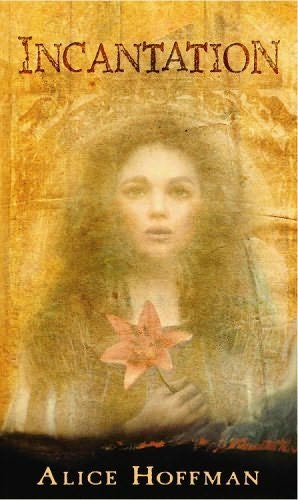
Incantation by Alice Hoffman

| | 2 comments »
Incantation by Alice Hoffman

Sometimes, when I'm looking around in a bookstore (or even the book section of Target), I'll write down authors names or partial titles on whatever I can find to write on. (sometimes, I'll even write text messages on my phone and save them if I don't have a pen)

I find these slips of paper weeks (or months) later and I have absolutely no idea what they mean. A couple of months ago, I found one on my desk that said Alice Hoffman. I'm sure I saw one of her books somewhere and thought it looked interesting, so, when I saw that she had a new book coming out, and that it was historical fiction, about Spain,* I knew I just had to read it.

And it was an absolutely beautiful little book, and very powerful, despite its brevity.

First of all, a little historical background -- in 1492, not only did Columbus sail the ocean blue, but Isabella and Ferdinand, los Reinos Catolicos (or Catholic Monarchs), united all of Spain under a Catholic government, expelling both the Moors (or Muslims), and the Jews. However, many people of both religions stayed in Spain (where they had lived for centuries -- the first Muslims having arrived in 711), and converted to Christianity (or pretended to). The Muslims who converted were called Moriscos, and the Jews, Marranos.

Incantation is the story of the Marranos and their suffering during the Spanish Inquisition. It is also the story of Estella, a 16 year old girl, of her discovery of her true heritage, and of her first love.

I would recommend this to anyone who enjoys historical fiction -- with one caveat -- one review I read somewhere (at this point, I have no idea where), the reviewer recommended this for elementary school or middle school, but I would have to say that while it is not too difficult to read, it is probably too dark for most elementary school students. (I know it would have been too dark for me... I mean it's been twelve years since I read Bridge to Terabithia, and I still haven't forgiven Katherine Patterson for the ending!)

*Spain-- I majored in Hispanic Studies, spent a summer in Spain, and I wrote my honors thesis on Spanish Historical Fiction for children -- so this is sort of an obsession of mine.

This is also why I find it really hard to write about the "Inquisition." I keep wanting to write "inquisición".